

01

Amica
Social wearable · Group project in interaction design
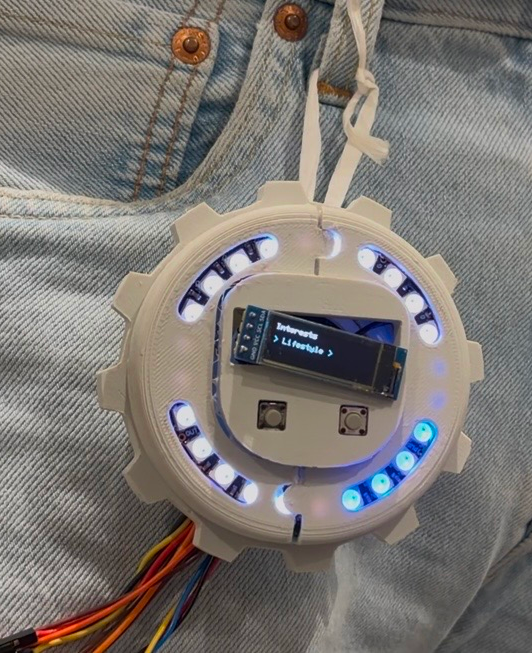
How could a wearable help exchange students find common ground at social events? Our group developed Amica, a device concept that lets people select interests and is intended to signal when someone nearby shares one of them. The aim was to offer a starting point for conversation while keeping attention on the people meeting each other.
My main contribution was creating the physical model. I planned how the available Arduino components would fit inside it, how the wires would pass through the enclosure, and how the parts could be assembled into a wearable prototype.

01
02

Understanding the users
The group spoke with international students about meeting new people in Gothenburg and evaluated the concept with them over two rounds. Their responses suggested that starting a conversation was not always the hardest part; finding enough common ground to keep it going could be more difficult.
This helped shift the use scenario towards social events, where people have time to talk. It also informed the decision to show four active interests and use clear visual signals, rather than overwhelming users and their surroundings with frequent or varied alerts.
02
Ideation & process
03
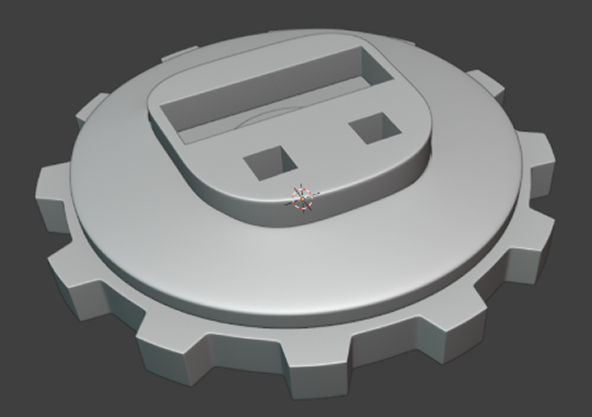
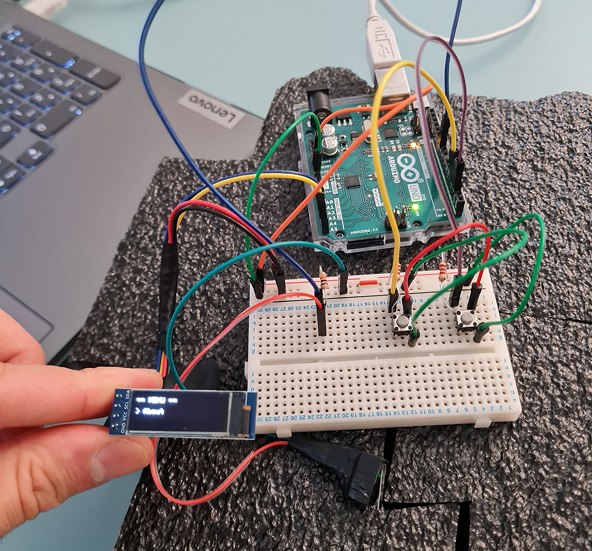
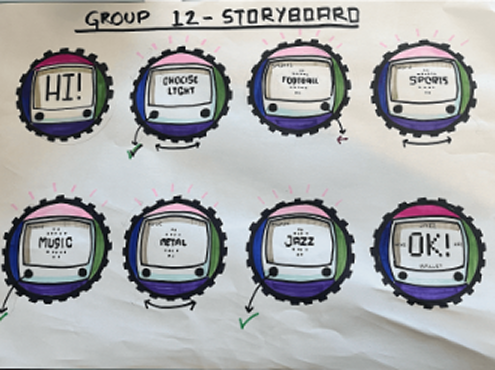
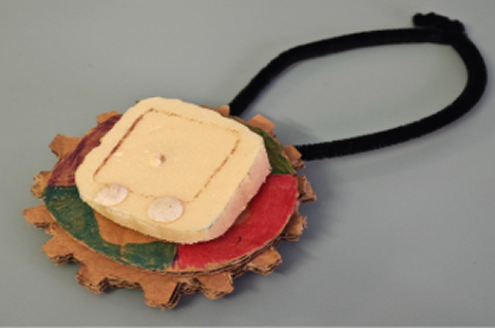
Amica developed through quick sketches, a LEGO model, a cardboard prototype and, finally, a 3D-printed enclosure. As the interaction became clearer, the group settled on a small screen, a ring of lights, a rotating gear and two buttons for navigating the menu.
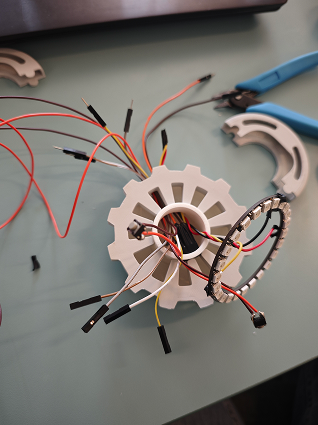
My challenge was to make that form work with the components we had available. I modelled the enclosure around their dimensions and planned routes for the wiring. The shape also had to account for printing, removing supports and putting the parts together afterwards. Those practical needs led to adjustments during modelling and assembly.
To give the gear a tactile role using limited hardware, it operates a single switch input. The two separate buttons are used for confirming and cancelling menu actions.
03
04
Final result
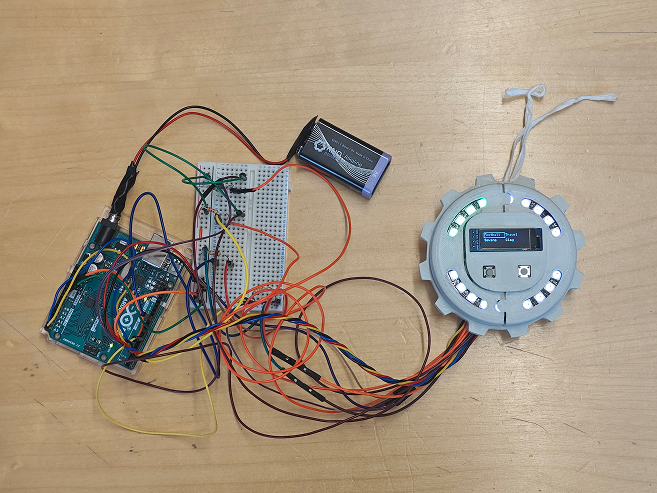
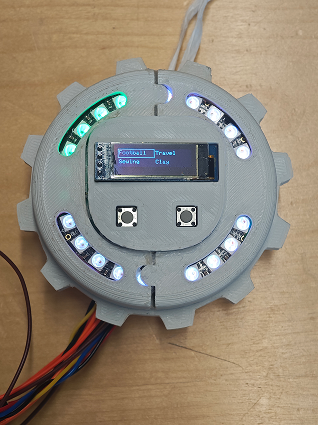
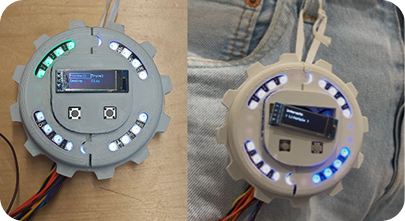
The final Amica prototype has a four-part 3D-printed shell with an OLED display, an LED ring and physical menu controls. The screen presents four selected interests, while different sections of the light ring provide visual feedback. To keep the wearable itself compact, the Arduino-compatible board remained outside the enclosure and was connected through an opening with wires.
We used the prototype to demonstrate menu navigation and lighting behaviour. The proposed automatic recognition between nearby devices was still a future technical challenge, and sound was illustrated in the concept rather than built into the physical prototype. The result could therefore communicate the intended interaction and wearable form while making clear which functions still needed development.
04
05
Key outcomes and learnings
This project taught me how to build a detailed physical prototype with limited components and fabrication resources. I learned to plan the enclosure, electronics and cable routing together, leaving room for assembly and adjustments from the first 3D model. Working with limited hardware also helped me find a simple tactile solution: a rotating gear operated through a single switch input.
The project made me think more carefully about what a prototype needs to do. We could demonstrate the menu and lighting physically while illustrating other parts of the intended experience. Being clear about that distinction helped me identify which functions would need further technical development.
05

Group projects
Individual projects
About me
Home
Contact
Urban design
Interaction
design
Playful
placemaking
Fish street
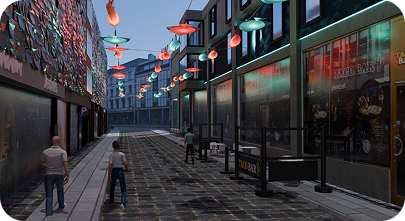
Fish Street reimagines a street in Gothenburg with playful installations and lighting that invite people to explore and interact.
Fish street
Concept
design
Industrial
design
Systems
thinking
The first & the last
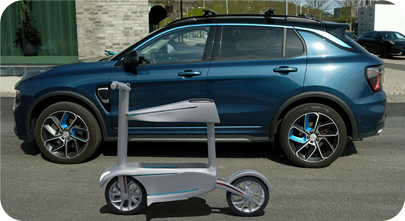
A speculative micromobility concept for 2030, designed to extend the Lynk & Co car experience and solve first- and last-mile urban transportation.
The first & the last
Interaction
design
User studies
3D-modeling
Social Gothenburg
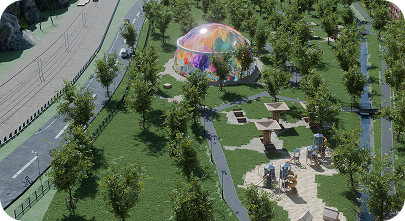
The goal was to design something for a set location in gothenburg, and find a way of making people socialise and connect with each other.
Social Gothenburg
Usability
User testing
Figma
Whitelines
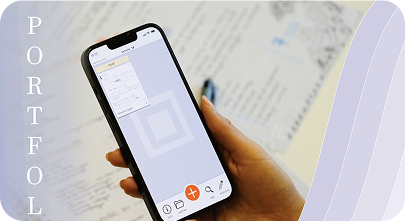
A project where we found issues with an existing interface and through user testing, made a redesign that was more efficient and less confusing.
Whitelines
Prototyping
Interaction
design
User testing
Amica
A personal gadget to assist in finding friends with similar interests as yourself. The theme was wearable and social.
Amica
Blender
Scene setup
Geometry nodes
Environments
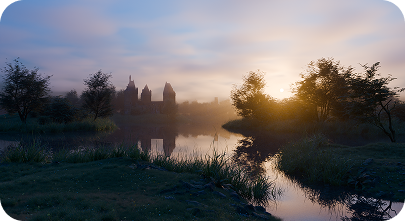
Doing landscapes was how i learned blender. I started of by copying a guide and with the later landscapes started doing some things of my own.
Environments
Blender
Scene setup
3D modeling
Car
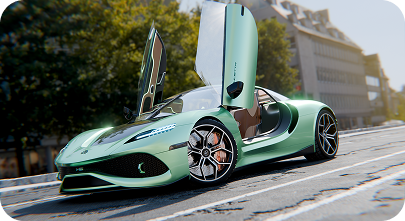
My biggest 3D modeling project where I modeled each surface of the exterior and interior of a car and made renders with hdri enviornments.
Car

Houdini
2D animation
VFX
Fun things
Some fun things from courses where I learned 2D animation and Houdini.
Fun things
Amica
